Skills and setup · October 22, 2026 · TelescopeBuddy Review Desk · 11 minute read
How to Stop a Telescope Shaking Before You Buy Accessories
Shorten your tripod legs, choose a firm support surface, and compare the view at the same low power before buying vibration accessories. Start with the setup you already own. A small change that lets you focus and release the knob comfortably is more useful than an accessory chosen without a diagnosis.
A bigger magnification number cannot repair a flexible mount. It makes the same angular motion look larger. Nor does every restless image come from the tripod: turbulent air, steady sky drift, and a snagging cable call for different fixes.
Affiliate disclosure: As an Amazon Associate, TelescopeBuddy earns from qualifying purchases. The optional listing link below is an affiliate link. Our research method and limitations explain the evidence behind this guide.
Decide whether this is a stability problem
This guide is for visual observers whose target jumps after a touch, a footstep, or a gust. Skip accessory shopping if the view is steady enough to enjoy after you let go. If your concern is a permanently blurred image, the telescope focus troubleshooting guide addresses that problem first.
Judge a proposed fix by four things: a repeatable trigger, the same observing power, a secure mechanical setup, and a shorter interruption to your observing. A fix that makes the tube unsafe or controls difficult to use fails even if the image seems quieter.
The whole target bounces after contact
Start with the tripod, mount head, and support surface. Release the focuser and note whether the motion fades. A useful trial is to shorten the legs safely, then repeat at the same power.
A starting check, not a definitive diagnosis. Wind and atmospheric turbulence can occur together.
The Instituto de Astrofísica de Canarias explains atmospheric seeing through turbulence. It can move or distort an image too, so an untouched view that wiggles is not proof of a defective tripod.
Try the free changes in a useful order
Change one thing, then compare. Otherwise you cannot tell which change helped. For example, leave the eyepiece in place while testing a lower tripod height; change observing power only in a separate trial.
- Stop touching the setup. Rest your hands away from the tube and keep your face from pressing against the eyepiece. After focusing, let go before judging detail. If the target settles, contact is at least one trigger.
- Lower the tripod safely. Follow the manual to retract adjustable legs or a raised center column. A seated position may let you keep it low without bending awkwardly. Do not adjust leg locks under an unsupported telescope.
- Check the support and connections. Confirm that feet cannot slip or sink. Seat the mount properly, secure the intended leg locks, and install a supplied spreader as directed. Tighten fastening hardware appropriately; do not force movement controls or internal adjustment screws.
- Separate the telescope from footsteps. A picnic table can move when someone rests an elbow on it. Test a tabletop setup on a firm support with nobody touching the table. A deck may require a different observing spot, rather than another accessory.
- Remove optional loads for the comparison. A phone, camera, or heavy eyepiece changes the configuration. Restore the normal visual setup first. Support the tube while following model-specific balance instructions, particularly before releasing an axis clamp.
- Check wind and cable contact. Compare in calmer conditions. Give cables the clearance prescribed by the mount manual so they cannot pull during movement. Keep any wind shelter clear of the telescope and secure against falling.
Sky & Telescope’s practical tune-up advice supports shorter tripod legs and comparisons of settling time. A support that helps one setup can behave differently with another, so keep a result only if your repeated comparison supports it. The apartment-balcony telescope guide covers the wider constraints of floor space and blocked sky.
Compare the interruption you actually notice
Use a bright star or a distinct lunar edge at night. Keep the target reasonably centered, retain the same eyepiece, and note wind conditions. Make a normal small focus adjustment, release the knob, and time from release until you would be comfortable judging detail. Do not strike the telescope or kick the tripod.
Repeat three times before the change and three times afterward. Use the middle value, or median, to reduce the influence of one unusually long or short trial. This is a rough visual comparison, not a laboratory vibration measurement. If the before and after timings overlap widely, treat a small difference cautiously and repeat on another suitable night.
Enter all six positive timings to compare your medians.
Your entries stay on this page and reset on reload. This calculation summarizes your observations; it does not measure the telescope or predict another setup.
Worked example, invented for the arithmetic only. Before entries of 4, 5, and 6 seconds have a 5-second median. After entries of 2, 3, and 4 seconds have a 3-second median. The calculation is (5 − 3) ÷ 5 × 100 = 40% shorter. These numbers describe no telescope or accessory, and say nothing about how much planetary detail you would gain.
Lower power changes what the same shake looks like
Magnification equals telescope focal length divided by eyepiece focal length. If you move from 40× to 80×, the same angular motion looks twice as large. The mount has not become less rigid; the view has become less forgiving. The magnification and exit-pupil calculator helps you choose a separate lower-power observing trial.
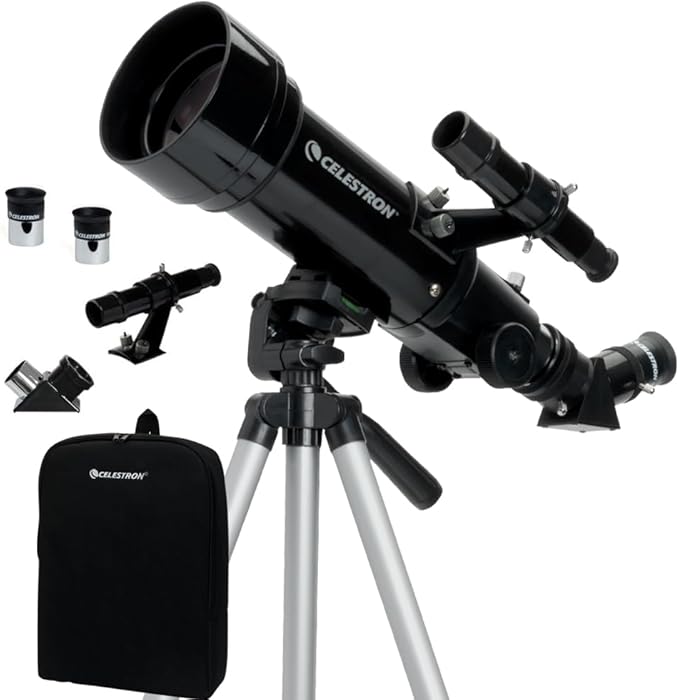
The Celestron Travel Scope 70 provides a concrete example. The manufacturer specifies model 21035 as a 70mm refractor with a 400mm focal length and manual alt-azimuth support. Its supplied 20mm and 10mm eyepieces yield 400 ÷ 20 = 20× and 400 ÷ 10 = 40×.
The kit includes a mount/tripod, 45° erect-image diagonal, 5×24 finder, backpack, and astronomy software access. A Barlow is not included in this standard kit. That matters because an extra high-power accessory should not be your first response to a view that already shakes.
For an owner of this kit, compare tripod changes with the same 20mm eyepiece first. Then separately decide whether 40× is comfortable. This is a worked optical calculation, not a measured stability review or a recommendation to replace your existing telescope. The light travel format does not establish its suitability for your preferred high-power observing.
Optional reference listing, standard model 21035, ASIN B001TI9Y2M: Exact Travel Scope 70 kit on Amazon. Match the model and contents before ordering; offers can change.
The Travel Scope instruction manual shows leg and center-column adjustments. Follow the instructions for the hardware actually supplied with your unit, rather than transferring a procedure from a different tripod.
Match a purchase to a remaining cause
Buy only when the free checks reveal a specific limit. A new accessory should solve a defined problem that survives a controlled comparison.
| Remaining symptom | Potential next step | Limit to accept |
|---|---|---|
| Footstep-related motion at the feet | Try a different surface first; consider compatible isolation pads afterward | Pads cannot make a flexible floor rigid |
| Motion mainly during focusing | Consider a compatible remote or motor focuser only after mechanical checks | It removes hand contact, not wind or structural flex |
| Flex persists with a secure, low setup | Assess a better-matched mount and tripod | Connection, load, tube length, and clearance all matter |
| Ripple over warm surfaces | Change the sight line or observing time | Tripod accessories cannot remove turbulent air |
For an equatorial setup, Celestron’s balance guidance includes a demonstration by astronomy product manager Lance Lucero. This is manufacturer guidance, not an independent consultation. Balance and any intended axis bias are mount-specific; do not copy a generic counterweight position.
A larger mount may also increase the load you must carry and the time you spend setting up. The telescope buyer’s anti-scam guide explains why mount suitability belongs ahead of headline power claims.
Skip fixes that add a new problem
Do not tighten every knob as hard as possible. Fasteners, axis clutches, bearings, and friction controls have different jobs. A control that becomes stiff can make smooth pointing harder. Stop if hardware is damaged or will not secure normally.
Do not add unsupported ballast. A swinging load can introduce motion and a hook may have no rated capacity. A chair and a lower setup can be the better no-purchase choice. Avoid loose weights near children or anyone’s feet.
Do not confuse tracking with stiffness. Steady drift calls for pointing or tracking corrections. On an equatorial mount, polar alignment is a separate setup check. Repeated motor jolts need the manufacturer’s troubleshooting process. Neither symptom justifies disassembling a drive in the dark.
Do not chase an atmospheric problem with mount accessories. A quiet support can still show a boiling planet. End the session if wind makes the setup unsafe. At night, choose a safe location with secure footing and keep equipment away from balcony edges.
Research method and limitations
This is a sourced troubleshooting guide, not a hands-on comparison. Research on October 22, 2026 checked manufacturer documentation, the rendered Amazon page for ASIN B001TI9Y2M, the IAC sky-quality FAQ, and published practical advice. The Amazon page identified model 21035 and showed an in-stock offer for its displayed US destination at that time; that is not a promise of current stock or delivery to you.
No telescope, support, vibration pad, or focuser was field-tested for this article. The named kit is evidence tier C, sourced. No settling time, wind threshold, or accessory improvement is claimed for it. The diagnostic tool suggests checks; the worksheet performs arithmetic on your entries. Visual timing has uncertain precision and results do not transfer between setups.
No expert was interviewed or engaged to assess this guide. The named manufacturer specialist is attributed only for published balance instruction. No product photographs are reproduced. Prices are omitted because they do not help diagnose shake, and no universal pad recommendation is supported here.
Questions after the first stability check
These answers cover the next decisions once you have separated a trigger from a guess.
Should I compare settling times at different magnifications?
No. Keep the same eyepiece, target, and telescope configuration for the before-and-after comparison. Higher magnification makes the same angular motion appear larger, so changing power changes your visual threshold for calling the image settled.
How should I record a settling trial interrupted by a gust?
Mark it as interrupted and repeat it in comparable conditions. Do not silently mix a windy trial with calm ones, or count a gust as an accessory failure. Keep the same eyepiece and configuration when you repeat the comparison, and stop if the wind makes the setup unsafe.
Will anti-vibration pads fix atmospheric seeing?
No. Pads act at the tripod feet. Atmospheric seeing comes from turbulent air along the light path. A rippling planetary image can persist even when the telescope and its support are mechanically steady.
Should I hang a heavy bag from any telescope tripod?
No. Use ballast only if the tripod manufacturer provides a suitable attachment and permits the load. A swinging bag can introduce motion, and an overloaded hook or spreader can fail. Shorter legs and a firm observing surface are better first checks.
Does a motorized mount eliminate vibration?
No. Motors provide pointing or tracking, while mechanical stiffness, balance, wind, cable drag, and the support surface still affect motion. A motorized mount can also need model-specific troubleshooting if jolts occur with nobody touching it.
Can a phone adapter make a previously usable setup harder to stabilize?
Yes. The extra load and its position can change balance and increase the force needed to hold or move the tube. Compare the original visual setup without the phone and adapter, then check permitted loads and balance before reinstalling them.
Is there one acceptable settling time for every telescope?
No. The useful threshold depends on magnification, target, observing task, and how you judge motion. Record repeated timings under comparable conditions and decide whether the remaining motion interrupts your actual observing. The worksheet provides no universal pass or fail score.
Will a new eyepiece make a flexible mount rigid?
No. A longer-focal-length eyepiece can make motion less conspicuous by reducing magnification, but it does not strengthen the mount. A heavier replacement eyepiece may also change balance. Fix the source of motion before treating optical accessories as a cure.